
How To Play Blackjack 2026 : Basic Strategy & Table Rules

Blackjack is one of the most popular casino table games because it combines simple rules with meaningful player decisions. The aim is straightforward: build a hand closer to 21 than the dealer without going over. While chance plays a role in every round, understanding card values, player actions, and blackjack strategy can help you make more informed decisions at the table.
If you want to learn how to play blackjack, this beginner-friendly guide explains everything you need to know, from the basics of the game and hand values to betting decisions, dealer rules, payouts, and common mistakes. By understanding how each part of a blackjack round works, you can approach the game with greater confidence and a clearer understanding of the rules.



What Is Blackjack?
Blackjack is a card game played between a player and a dealer. Despite what it might look like at a crowded table, you are not competing against the other players sitting next to you. Every hand is a one-on-one contest against the dealer.
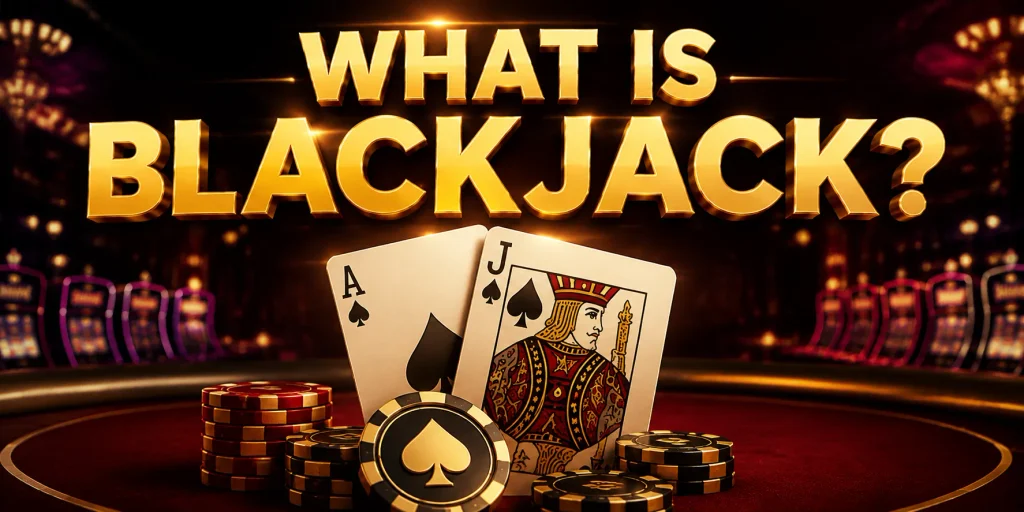
The goal is straightforward: get your cards as close to a total of 21 as possible without going over. If your hand exceeds 21, you “bust,” and you lose your bet immediately, even if the dealer later busts too.
A hand resolves in one of three ways. You win if your final total is higher than the dealer’s without going over 21, or if the dealer busts. You lose if your hand busts, or if the dealer’s total beats yours. And you push, meaning your bet is simply returned, if your hand and the dealer’s hand land on the same total.
That’s the entire foundation of the game. Everything else, including strategy and betting decisions, builds on this simple premise.
Understanding Blackjack Hand Values
Before you can make good decisions at the table, you need to know how each card is valued. Blackjack hand values are simple once you see them laid out. Number cards, 2 through 10, are worth their face value. Face cards, meaning the Jack, Queen, and King, are each worth 10. Aces are the exception, since they can count as either 1 or 11, whichever benefits your hand more.
Because the Ace is flexible, blackjack hands are described as either “hard” or “soft.” A hard hand has no Ace, or an Ace that can only count as 1 without busting. A soft hand contains an Ace counted as 11.
A few quick examples make this clearer. A hand of 10 + 7 equals 17, and since there’s no Ace involved, it’s a hard 17. A hand of Ace + 7 equals 18, and since the Ace counts as 11, it’s a soft 18. A hand of Ace + 9 + 5 equals 15, but here the Ace must count as 1, since counting it as 11 would push the total to 25, so this is a hard 15.
Understanding the difference between hard and soft hands matters because it directly affects how you should play a hand, which we’ll cover in the strategy section below.
How To Play Blackjack Step By Step?
Now that you know the basic goal and how cards are valued, here’s what actually happens during a round.
1. Choose A Table And check The Limits.
Every blackjack table displays a minimum and maximum bet. Pick a table that fits your bankroll comfortably.
2. Place Your Initial Wager.
Before any cards are dealt, you place your chips in the betting circle.
3. Receive Your Opening Cards.
You’ll get two cards face up. The dealer also deals themselves two cards, but typically only one is shown.
4. Look At The Dealer’s Upcard.
This single visible card is one of the most important pieces of information you have. It heavily influences which action you should take.
5. Choose Your Action.
Based on your hand and the dealer’s upcard, you decide whether to hit, stand, double down, split, or in some cases, surrender.
6. Complete Your Hand.
You keep making decisions until you either stand, bust, or reach a hand you’re satisfied with.
7. The Dealer Reveals Their Hidden Card And Plays Their Hand.
The dealer follows fixed rules, not personal judgment, when deciding whether to take more cards.
8. The Outcome Is Determined And Payouts Are Made.
Bets are settled based on whose hand is closer to 21 without busting.
This sequence repeats for every new round, and once you’ve played a few hands, the rhythm becomes second nature.
Blackjack Player Decisions
Once your first two cards are dealt, you’ll need to choose an action. The hit or stand blackjack decision is the one you’ll face most often, but a few other options come into play depending on your hand.
Hit
Hitting means taking another card from the dealer. Players typically hit when their hand total is low enough that another card is unlikely to cause a bust. For example, a hand of 8 + 6 (14) is often a hit, since there’s little risk compared to the potential gain.
Stand
Standing means keeping your current hand and taking no more cards. This is common when your total is high enough that hitting carries significant bust risk, such as a hard 17 or higher.
Double Down
Doubling down lets you double your original bet in exchange for receiving exactly one more card. This is typically used when the player’s starting hand has a strong opportunity to improve with one additional card, depending on the dealer’s upcard and table rules.
Split
If your first two cards are a matching pair, such as two 8s, you can split them into two separate hands. This requires placing a second bet equal to your original wager. Each card then becomes the first card of its own hand, and you play both hands independently.
Surrender
Some casinos offer a surrender option, which lets you forfeit half your bet and end the hand immediately instead of playing it out. This option isn’t available everywhere, so it depends on the specific casino’s house rules. When available, it’s typically used on particularly weak starting hands against a strong dealer upcard.
How To Improve At Blackjack?
Step 1: Learn Basic Strategy
Start by understanding basic strategy so you can make more informed decisions in common situations.
Step 2: Practice Regularly
Practice your hand decisions to build confidence and improve consistency.
Step 3: Understand The House Edge
Learn how the house edge works and how different decisions can affect your long-term results.
Step 4: Improve Decision Making
Focus on reducing mistakes by making strategy-based decisions instead of relying on luck or guessing. Understanding how players approach decisions correctly is a key part of improving at blackjack.
Step 5: Compare Table Rules
Check rules such as payout ratios, number of decks, and dealer requirements before you play, as they can influence the game’s mathematical advantage.
Step 6: Review Your Decisions
After each session, look back at hands you found difficult to identify areas where you can improve.
How The Dealer Plays?
One of the more comforting aspects of the game for new players is that the dealer doesn’t get to make strategic choices. Dealer actions generally follow predetermined house rules rather than personal judgment.
The dealer receives two cards, one face up and one face down, and reveals the hidden card only after all players have finished their hands. From there, dealer actions are fixed: the dealer must hit on a total of 16 or lower and must stand once the total reaches 17 or higher.
The one variation to watch for is soft 17. Some casinos require the dealer to stand on any 17, including a soft 17, while others require the dealer to hit a soft 17. Other table conditions, such as the number of decks used and available player options, can also influence the way the game is played.
Blackjack Payouts Explained
Once the hand is over, payouts are determined by comparing your final total to the dealer’s. A standard winning hand pays out at even money, meaning a $10 bet wins $10. A natural blackjack, which is an Ace paired with a 10-value card dealt on your first two cards, typically pays more than a standard win. A common payout ratio at many tables is 3:2, though this can vary by casino and isn’t universal. A push occurs when your total matches the dealer’s, and your original bet is simply returned.
A losing hand, whether from busting or from the dealer having a higher total, results in the loss of your wager. Payout structures can differ from one casino to another, so it’s always worth confirming the specific table’s rules before you sit down to play.
Basic Blackjack Strategy
Blackjack decisions are based on understanding the situation rather than relying on guesses. The right choice depends on several factors, including your hand total, whether the hand is hard or soft, whether you have a pair, and the dealer’s visible card.
Because every possible hand combination creates different scenarios, many players use a blackjack chart as a reference. These charts show the recommended action for different situations, including when to hit, stand, double down, or split. Blackjack basic strategy helps players make more consistent decisions by following mathematically informed choices, although it cannot predict the result of any individual hand or guarantee wins.
Common Blackjack Mistakes Beginners Should Avoid
New players often make a few predictable mistakes. Avoiding them can help you play more consistently.
1. Chasing Losses: Increasing bets to recover losses can quickly increase your risk.
2. Ignoring The Dealer’s Upcard: The dealer’s visible card should factor into your decisions.
3. Misunderstanding Insurance: Insurance is a side bet offered when the dealer shows an Ace and may not suit every player.
4. Confusing Blackjack With 21: A natural blackjack is an Ace and a 10-value card as the first two cards, while a 21 made with three or more cards is different.
5. Betting Emotionally: Increasing wagers after a loss out of frustration can compound losses.
6. Ignoring Table Rules: Always check rules such as blackjack payouts and whether the dealer hits or stands on soft 17.
Tips For Playing Blackjack As A Beginner
If you’re new to blackjack, start by learning hand values and understanding the table’s rules before placing a bet. Once you’re comfortable with the basics, learn basic strategy to make more consistent decisions.
Set a budget before playing and stick to it, keep your bet sizes consistent, and avoid chasing losses. Taking regular breaks can also help during longer sessions. Most importantly, treat blackjack for beginners as entertainment rather than a guaranteed way to make money.
Responsible Gambling
Responsible gambling means treating blackjack as entertainment rather than a way to make guaranteed income. Players should set a fixed budget before playing, avoid using money needed for essential expenses, and take regular breaks during sessions. Keeping track of spending, avoiding chasing losses, and knowing when to stop are important parts of maintaining control. Understanding the risks and playing within personal limits can help create a safer and more balanced approach to casino games.
Conclusion
Learning how to play blackjack comes down to understanding a handful of core ideas: how hand values work, what happens during a typical round, the actions available to you, and how the dealer’s fixed rules shape the game. Once you’re comfortable with the blackjack rules and hand values, basic strategy gives you a consistent framework for decision-making at the table.
Blackjack rewards patience, understanding, and informed decisions far more than it rewards guessing. Focus on learning the fundamentals well, and the rest of the game will start to feel a lot less intimidating.
FAQs About Playing Blackjack